The Flag on a Product Is Not Its Whole Origin Story
A product’s country label gives a useful clue, not a full supply-chain account. Learn how to read it and what to check for different decisions.
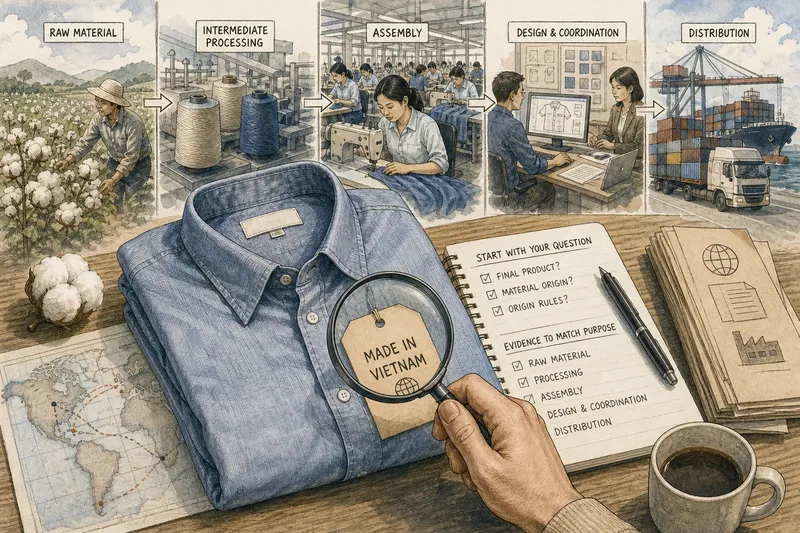
A product’s country-of-origin label names one place, while its supply chain may span several. A shirt marked “Made in Vietnam”, for instance, could use cotton grown elsewhere, yarn spun in another country and buttons sourced from a third. The label is not necessarily misleading; it answers a narrower question than many readers think it does.
The right way to read it depends on why you are looking. A shopper comparing broad provenance, a student tracing value chains and a business checking trade rules need different evidence. Treat the label as the cover of a file, not the whole file.
Start with your question
Before interpreting a country name, decide what you want to know. “Where was the final product made?” differs from “Where did the materials come from?” and both differ from “Which country’s rules assign its origin?” Those answers can overlap, but they need not.
- For a quick purchase decision: use the label as a concise statement about origin, while recognising that it does not usually list every input or supplier.
- For a supply-chain account: look for information on raw materials, processing, assembly and the firms that connect those stages.
- For a trade or customs question: identify the specific product and destination, then consult the applicable origin rules rather than inferring them from a retail label.
- For a study assignment: separate what the label states from what you can document about the production network.
These are not competing versions of the truth. They are different levels of description. A label is like a return address on an envelope: useful for orientation, but no account of every place the letter passed through.
What the label says
Country-of-origin marking is a short claim attached to a finished good. In many contexts, rules connect origin to where a product was made or where a substantial transformation occurred. The precise test depends on the product, the route and the relevant jurisdiction.
That distinction matters because the place of assembly may carry more weight for the origin claim than the places supplying components. A bicycle assembled in one country can contain a frame, gears, tyres and electronic components made elsewhere. Its label may identify the country regarded as the origin under the rules that apply, not a complete map of those parts.
Nor does a flag or country name on packaging necessarily explain the claim. It may refer to design, branding, a company’s headquarters or a particular production stage. Read the wording around it: “designed in”, “assembled in” and “made in” are not interchangeable descriptions.
Where a legal or customs decision depends on the origin of a particular good, rely on the relevant product-specific rules and a qualified customs professional where needed. A retail label is not a substitute for that determination.
When one place is enough
If you want a simple indication of where a finished item was made, the label may fit your purpose. It gives a clear starting point without requiring a miniature supply-chain report on the box. For ordinary comparison, that can be enough, provided you do not read a broader claim into it.
It is less useful if your decision rests on the source of a key material, the location of a particular production stage or the distribution of economic value. A “Made in” statement does not, by itself, tell you where cotton was grown, where fabric was dyed or where most of the work took place.
Say you are comparing two cotton shirts because you want to know where the cotton was grown. Both labels name the countries where the shirts were assembled. You would need a fibre-origin statement or supplier information to answer your actual question; choosing between the two labels alone would not settle it.
When the chain matters
For a fuller account, trace the product through its main stages rather than collecting country names without context. A useful map distinguishes at least:
- Raw material: where the main natural or extracted inputs originated.
- Intermediate processing: where materials were refined, spun, cut, treated or turned into components.
- Assembly: where components were brought together into the finished good.
- Design and coordination: where product specifications, purchasing and supplier relationships were managed.
- Distribution: where the item was stored, sold or delivered to its destination.
Not every product has a neat sequence. A component may pass through several processors; some suppliers may not disclose their own sources. A supply-chain account should therefore distinguish documented facts from gaps, estimates or broad descriptions. Listing a country beside each stage is not enough if the stage itself remains unclear.
Information can come from product disclosures, company sourcing documents, supplier declarations, certification records or direct answers from the seller. Each source has limits. A general sustainability page may describe company policy rather than the specific item in your hand, while a supplier list may identify factories without describing where their materials came from.
What do you need to know?
Does “Made in” mean every part comes from that country?
No. The statement usually concerns the finished product under the applicable marking rules, not the origin of each component. To trace materials, look for separate sourcing disclosures or product-level supply-chain information.
Is “assembled in” the same as “made in”?
Not necessarily. “Assembled in” points to a particular production stage, while “made in” may be governed by a legal origin test. Their meaning can depend on the wording, product and market.
Can I tell a product’s full origin from its barcode?
Usually not. A barcode prefix is associated with the organisation that registered it, and does not by itself establish where the product or its parts were manufactured. Treat it as an identifier, not an origin certificate.
What should I ask a seller?
Ask which stage the country claim refers to and whether the answer applies to the specific product or only to the brand’s general sourcing policy. If material origin matters, ask for that information directly rather than assuming the seller’s first answer covers it.
Match evidence to purpose
The most useful evidence is the evidence that answers your question. A country label may be adequate for a broad impression. A named factory or assembly location can clarify where final production occurred. Material records, processing disclosures and supplier documentation are more relevant when the question concerns upstream inputs.
For a student analysing global commerce, keep the claims in separate columns: label wording, production stage, country named, source of evidence and what remains unknown. This prevents a common mistake: turning a narrow statement into a story about the whole chain. It also makes uncertainty visible instead of burying it in polished prose.
For a business evaluating sourcing, the same distinction helps organise questions to suppliers. Ask for the product scope, the stage covered and the date or version of the information. A disclosure about a brand’s general purchasing network may not describe a particular model or production run. Where origin affects customs treatment, documentation should be checked against the relevant rules, not inferred from marketing language.
Read the claim precisely
Country labels are useful because they compress information. Their limitation is the same: compression leaves detail out. Read the exact phrase, identify the stage it describes, and decide whether that stage answers your concern.
If it does, the label may be all you need. If it does not, ask for the missing link: the material, process, supplier or rule that would make the account relevant. A product’s country label is a starting point for understanding origin, not a verdict on every part of its history.