A One-Page Trade Reading Log for a Study Session
A one-page trade reading log keeps a study session focused on claims, unfamiliar terms and useful questions, without copying the text into your notes.
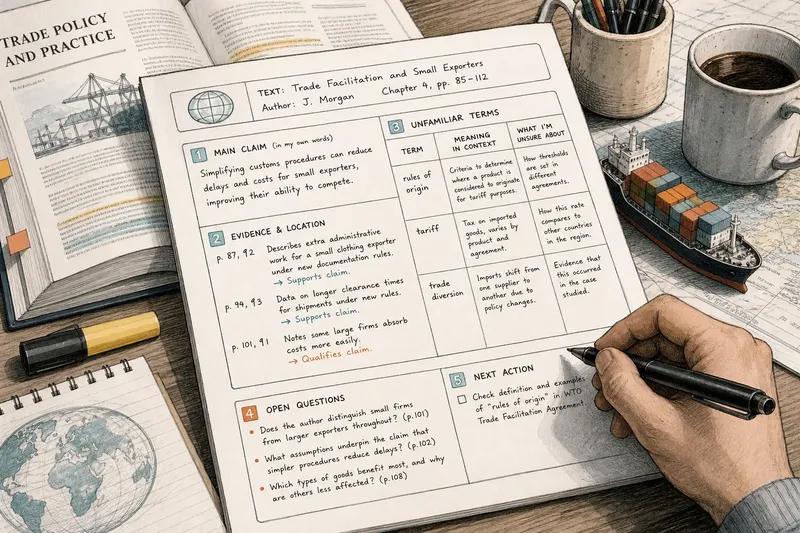
A one-page trade reading log works best when it records decisions about a text, not a smaller version of the text itself. If a chapter on tariffs or trade agreements leaves you with several copied paragraphs and no clear sense of its argument, the problem is usually the note-taking format: it rewards transcription instead of attention.
A compact log gives you a place to state the author’s main claim, mark terms that need checking and preserve questions for later. The difficulty is keeping those tasks distinct, especially when a reading feels dense. Treat the page like a desk tray with separate compartments: each note has a job, and nothing needs to occupy the whole surface.
Claims buried in detail
Problem: Your log contains many details but no sentence that says what the text is arguing.
Usual cause: You are recording information in the order it appears. A trade text may move from a policy change to an industry, then to an exception; following every turn can obscure the point the writer wants readers to accept.
Try this: Before writing notes, scan the title, opening and closing paragraphs, then read the full text. At the end, complete one prompt: “The author’s main claim is that…” Keep the answer in your own words and make it a claim someone could question, not a topic label. “The text discusses customs procedures” names a subject; “Simplifying customs procedures can reduce delays for smaller exporters” states an argument.
If you cannot write the claim yet, leave the line blank and mark the paragraph that seems central. A blank prompt is more honest, and more useful, than a polished sentence assembled from guesses.
Notes becoming a summary
Problem: You have retold each section, but the log is already full.
Usual cause: You are treating every example as equally important. Summaries often reproduce the text’s sequence; a reading log should show what you understood, what you need to verify and what you want to ask next.
Try this: Limit yourself to a small set of evidence notes. For each, record a paragraph number or short locator, then add a few words on how that passage supports, qualifies or complicates the main claim. Do not copy whole sentences unless you need a brief quotation for a specific reason; mark quotation marks and the page clearly if you do.
Imagine you are reading a case study about a clothing exporter facing new documentation requirements. You write the claim in your own words, note that one paragraph describes extra administrative work, and add: “Does the author distinguish small firms from larger exporters?” The log captures the argument, one relevant detail and a question, without retelling the case study.
Terms without meaning
Problem: Your unfamiliar-terms column is crowded, but the words still feel vague.
Usual cause: A term has been copied without its context. Trade vocabulary can shift meaning across settings: “origin”, for instance, may refer to a product’s origin under a particular rule rather than the place a reader would casually associate with its manufacture.
Try this: For each term worth keeping, write the sentence’s local meaning, your best provisional explanation and what remains uncertain. Separate “I understand this in the passage” from “I can define this confidently”. That distinction makes later checking more targeted.
Keep the list selective. If a word is ordinary, repeated and clear from context, it may not deserve space. Prioritise terms that affect the author’s claim, such as tariff, quota, trade diversion or rules of origin. Where meaning depends on a source’s definition or a particular agreement, note the passage or document to consult rather than treating your guess as settled.
Questions too broad
Problem: Your open question says something like “How does trade work?”
Usual cause: The question is disconnected from a specific passage, distinction or uncertainty. A broad question can be interesting while still being difficult to answer during the next study session.
Try this: Tie each question to a claim, term or piece of evidence. Ask what comparison the author has not made, which assumption the argument relies on, or what information would change your interpretation. Put a short locator beside the question so you can return to its source without rereading the entire text.
Keep questions open rather than turning them into disguised requests for a definition. “Which firms face the added paperwork described here?” can guide further reading; “What does paperwork mean?” probably cannot.
When should the log change?
What belongs on the one-page log?
Use four compact fields: the text’s main claim, supporting evidence with locators, unfamiliar terms with provisional meanings, and open questions. Add the text’s title or citation at the top so the page remains identifiable when separated from your reading.
Should I write while reading?
Mark passages as you go, but draft the main claim after you have seen the whole argument. This keeps an early example from standing in for the author’s full position.
What if the text has several claims?
Write the central claim first, then note a secondary claim only if it changes or limits the main one. If the argument is genuinely divided, record that tension instead of forcing it into a single neat sentence.
How do I use the log later?
Begin the next session with the open questions and the passages they point to. Update a provisional term or claim when the text itself resolves it, and leave unresolved questions visible for another source or discussion.
A usable page layout
Make the format repeatable by using the same headings for each reading. A notebook page or a simple document is enough; elaborate templates tend to invite elaborate filling-in.
- Text: title, author or organisation, and a locator such as chapter or page range.
- Main claim: one sentence in your own words.
- Evidence and location: a few brief notes on passages that support, qualify or challenge the claim.
- Unfamiliar terms: term, meaning in context, and any uncertainty to check.
- Open questions: specific questions linked to a passage or claim.
- Next action: one modest task, such as checking a defined term or comparing the author’s account with a course reading.
When space runs short, cut repeated details before shrinking the writing or dropping the questions. The purpose of a one-page trade reading log is not to prove that every paragraph was noticed; it is to leave you with a clear claim, a few traceable reasons to take it seriously, and a precise indication of what you do not yet know.